.png)

Utilities have invested heavily in data over the past decade. SCADA systems, asset management platforms, GIS, and reporting tools provide unprecedented visibility into system performance. Yet visibility alone doesn't create understanding.
As experienced operators retire and system complexity grows, many utilities are discovering that data tells them what is happening, but not always what it means. Teams can see trends, alarms, and anomalies, yet still struggle to interpret them with confidence when conditions fall outside the norm.
The stakes are significant. Without the ability to connect data to operational experience, utilities face growing challenges around efficiency, asset management, compliance, resilience, and workforce readiness. The question is no longer whether utilities have enough data, but whether they can turn that data into confident decisions.
When experience leaves, the gap becomes visible
Consider a familiar scenario: a long-tenured operator retires after decades of service. Over time, they’ve built an intuitive understanding of how the system behaves under a wide range of conditions. They have knowledge shaped beyond documentation, through years of experience.
Soon after they retire, a subtle issue emerges: a pressure fluctuation in part of the network. It doesn’t trigger alarms, and it seems to sit within acceptable thresholds. On paper, everything appears normal.
The team can see the deviation, but they can’t confidently determine what it means or what to do next. They have the data, but what’s missing is the interpretive layer that connects current conditions to past experience.
This scenario highlights a broader challenge facing utilities today. Critical operational knowledge often lives with individuals rather than systems. It shapes how teams interpret data, recognize risk, and respond to changing conditions, yet much of it remains undocumented and difficult to transfer.
When that expertise leaves, investigations take longer, training becomes more difficult, and confidence becomes concentrated within a shrinking group of experienced staff. This is the knowledge gap: the inability to interpret data with confidence.
The limits of dashboard-driven operations
There’s no denying that dashboards are essential. But they’re not designed to replace experience, and that’s where the gap becomes clear.
Most dashboards are built around predefined metrics, thresholds, and visualizations. That is, they work well when systems behave as expected. But when conditions shift, their limitations surface:
- Threshold dependency
Alerts are tied to known limits. Early signals and subtle deviations often go unnoticed, even when they point to emerging issues.
- Fragmented context
Data may be consolidated visually, but it isn’t inherently connected to past events, decisions, or outcomes.
- High interpretation burden
Teams must still analyze, prioritize, and act, often relying heavily on individual experience to do so.
The result: more dashboards can actually increase complexity without improving clarity.
Moving from visibility to operational intelligence
Closing the knowledge gap requires more than collecting information. It requires connecting data with experience and delivering that insight at the point of decision. This is where many utilities are beginning to rethink their approach: by building a strategy for how AI can support operations.
An AI Master Plan provides that foundation. Rather than deploying AI in isolated projects, an AI Master Plan aligns data sources, operational priorities, governance frameworks, and AI use cases within a broader vision for the utility.
By taking this approach, utilities can focus on initiatives that deliver near-term value while building toward long-term resilience. More importantly, they create a framework for preserving, scaling, and applying institutional knowledge across the organization.
A strategic partner for the AI journey
Building and executing an AI Master Plan requires deep domain understanding, thoughtful planning, and the ability to translate strategy into operational reality.
Different utilities are at very different stages in their AI journey. Some might be just beginning to explore where AI could add value, while others have already invested in digital systems but lack a clear roadmap for scaling. In both cases, success depends on having the right expertise to guide the process.
This is where partnering with experts like Trinnex becomes critical. Trinnex works alongside utilities to meet them where they are, helping define practical AI strategies, develop roadmaps, and establish secure, utility-ready foundations for AI adoption. This includes:
- Translating operational challenges into prioritized AI use cases and developing AI Master Plans and digital roadmap through Data & AI Consulting
- Establishing cybersecurity-first architectures to support AI safely through Cybersecurity Consulting
- Supporting domain-specific implementation that fits real utility workflows and embedding AI into day-to-day operations through Custom Software Solutions
Rather than treating AI as a standalone deployment, this approach ensures each step forward is aligned with operational priorities, regulatory realities, and workforce needs.
Turning strategy into operational reality
Once a utility has established the strategic foundation for AI adoption, the next step is applying that strategy to operational challenges. One of the most immediate opportunities is preserving and scaling institutional knowledge.
Within that framework, solutions like Raini introduce a fundamentally different approach.
.png)
Rather than adding another layer of visualization, Raini helps utilities understand operational data in context by connecting current conditions with historical knowledge, operational experience, and information across existing systems.
Contextual understanding
Raini brings together information from systems such as SCADA, GIS, IoT platforms, and standard operating procedures, helping operators understand not just what is happening, but why it matters.
Operational guidance
By linking current conditions to relevant historical scenarios and utility-specific knowledge, Raini helps teams investigate anomalies faster, evaluate response options, and make decisions with greater confidence.
Utility-specific intelligence
Purpose-built for water and wastewater operations, Raini provides practical, operator-focused intelligence designed around real utility workflows rather than generic AI outputs.
This approach shifts the focus from simply monitoring conditions to understanding them and acting with confidence.
Building a more resilient, AI-ready workforce
One of the most significant benefits of operational intelligence is its impact on workforce resilience.
As utilities navigate a multitude of workforce changes, the ability to extend knowledge across the workforce becomes increasingly important. By embedding operational experience into daily workflows, utilities can reduce reliance on a small group of experts, accelerate onboarding, improve consistency, and strengthen collaboration.
This is not about replacing experienced professionals. Rather, it’s about ensuring their expertise continues to inform operations long after they leave the control room.
The impact extends beyond workforce development. Utility operations rarely happen under perfect conditions. Data can be incomplete, signals can be ambiguous, and time is often limited. In these moments, context becomes one of the most valuable assets an organization possesses.
With context-driven intelligence and the right AI foundation in place, teams are better equipped to identify early indicators of potential issues, evaluate likely causes based on historical patterns, and choose response strategies with greater confidence. The result is more consistent decision-making and reduced risk of escalation or service disruption.
A practical path forward
For utilities evaluating how to address the knowledge gap, several steps are worth considering:
- Identify where critical knowledge lives
Identify roles and individuals whose experience is essential to current operations. Consider how their knowledge is currently shared and where gaps exist.
- Reassess how data is used
Determine whether teams can connect real-time conditions to historical context, or if analysis is largely reactive.
- Define your AI roadmap
Prioritize use cases that deliver immediate value while supporting long-term transformation (this is the backbone of an effective AI Master Plan). Many utilities partner with experienced advisors to build this roadmap, ensuring the right balance of strategy, security, and practical implementation.
- Invest in contextual intelligence
Look beyond aggregation tools to solutions that align with your AI Master Plan by integrating data with operational experience.
- Embed knowledge into workflows
Ensure knowledge is accessible at the point of decision—not buried in systems or documentation.
Conclusion
Utilities have made significant progress building data-rich environments. But the next phase of transformation is about better use of that data. Dashboards will remain important, but they’re only part of the solution.
Bridging the knowledge gap requires a more intentional approach—one that connects expertise, data, and decision-making through a clear strategy. In other words, an AI Master Plan.
Delivering on that vision requires both the right strategy and the right solutions. Trinnex helps utilities build and execute an AI Master Plan, connecting digital strategy, secure implementation, and domain expertise across the organization.
Within that journey, Raini represents a key step: helping utilities bridge the knowledge gap by connecting data with operational context and experience and enabling more confident decisions across their teams.
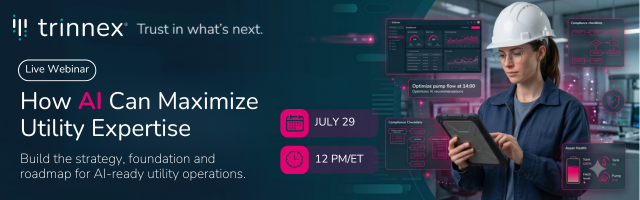
Interested in learning more about how AI can maximize utility expertise? RSVP for our upcoming webinar.
👉 How AI Can Maximize Utility Expertise
We’ll explore:
- Building a practical roadmap for AI adoption
- Creating a secure, AI-ready foundation
- Identifying high-impact use cases that deliver long-term resilience