.png)

Water and wastewater utility managers are under unprecedented pressure to operate with greater resilience than ever. Many face looming deadlines including the AWIA Risk and Resilience recertification (June 2026), and the Lead and Copper Rule Improvements (LCRI) baseline inventory (Nov 2027) as well as heightened risks related to the emergence of AI, and the reality that a “50‑year storm” now seems to take place every other season. We at Trinnex see this every day: utilities balancing regulatory expectations, aging infrastructure, siloed data, and the growing risk that institutional knowledge walks out the door with each retirement.
When pressure builds, the instinct is to fix the most visible pain point as quickly as possible with the best tool available. But modernization that will stand the test of time shouldn’t start with a dashboard or a new software app. It should start with a Digital Master Plan: a clear blueprint for success that more cautiously leads to resilient operations.
From Reactive Operations to Predictive Insight
Utilities are exceptionally good at keeping systems running with very limited resources. Spreadsheets, paper logs, work‑arounds, and institutional memory have carried many teams for decades. But what once enabled flexibility has quietly become a risk.
When data is fragmented across SCADA, LIMS, GIS, and spreadsheets, visibility and subsequent action are delayed. Compliance trends surface too late. Alarms trigger after thresholds are crossed. Reporting becomes a time-consuming, error prone scramble.
A Digital Master Plan—what we often describe as a digital roadmap—shifts operations from reactive to predictive. It evaluates the utility organization with a holistic approach, identifying gaps across both digital systems and physical infrastructure. The goal is operational resilience where decisions are informed, timely, and defensible.
Tapping into Domain Expertise: Building Solutions Around Your Utility
At Trinnex, we realize that every utility is in a different state of technology adoption. Some have invested heavily over long periods of time; others have only just begun their journey. Our success has led us to an approach that can help utility managers succeed in reaching their goals regardless of the current state. In today’s highly complex digital landscape, expert consulting must accompany technology selection and implementation because it only delivers long-term value when it supports real workflows, real operators, and real constraints.
Our approach follows a practical Crawl, Walk, Run, Fly progression designed to minimize disruption while building long-term capability.
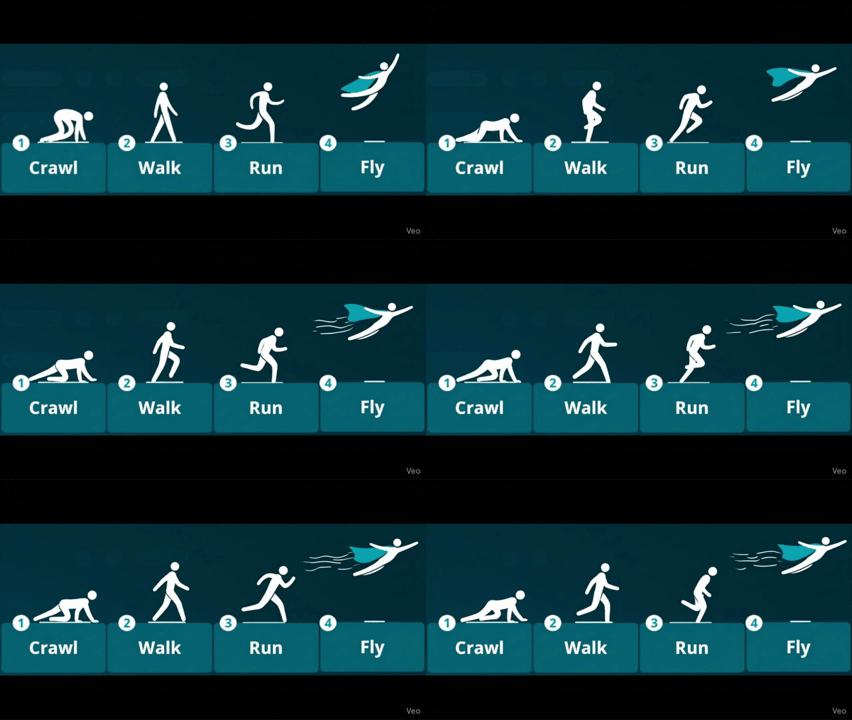
Crawl: Assess and plan with a digital roadmap
Meet with stakeholders to identify key goals and future vision, as well as resources and roadblocks to achieve those goals. Assess and benchmark key data systems such as SCADA, LIMS, asset, and GIS.
Walk: Enable shared, real‑time visibility
With integrated data systems, operations and compliance teams gain a continuous view of system performance and permit alignment without relying on static spreadsheets or after‑the‑fact reports. Manual work is reduced, reporting gaps are eliminated.
Run: Move upstream of risk
Predictive analytics and AI assisted insights identify how quickly trends are moving toward limits, giving teams days or weeks of lead time to intervene before alarms or violations occur.
Fly: Operationalize continuous improvement
Modernization becomes intentional, not disruptive. Utilities embed data driven decision‑making into daily operations, continuously optimizing performance, strengthening resilience, and adapting confidently to evolving regulatory and system demands.
Cybersecurity That Protects Operations
AWIA has rightly elevated attention on resilience against malevolent acts. But modern threats are no longer limited to ransomware. Increasingly, disruptions are caused by misuse of legitimate access, targeting availability and continuity rather than data alone.
A Digital Master Plan prioritizes cyber resilience. A business network incident should never become a treatment process failure.
Working alongside our parent company, CDM Smith, we design security architecture purpose-built for SCADA and industrial control systems. The objective is simple: no matter what happens in the digital environment, the physical system continues to deliver safe, reliable water.
Addressing the Workforce Reality with Knowledge Retention
The workforce challenge is not hypothetical. As experienced operators retire, decades of decision-making context often leave with them. That institutional knowledge is critical to resilience and increasingly difficult to replace.
Digital roadmaps allow utilities to capture and operationalize that expertise. By combining historical records, SCADA data, and AI‑enabled knowledge agents, utilities can embed operator insight directly into daily workflows. New staff gain context, confidence, and decision support without replacing the human element.
The result is a digital first workforce that is prepared, supported, and resilient.
Why the Blueprint Matters Now
Regulatory complexity isn’t slowing down. With evolving requirements like the LCRI, data volume, speed, and traceability are only increasing. Spreadsheets are not designed to support dynamic inventories or three-day notification requirements at scale.
Utilities that invest in a Digital Master Plan today are gaining a roadmap that helps prioritize capital and operational investments, align digital initiatives, and proactively strengthen infrastructure resilience.
Building What Lasts
At Trinnex, we don’t lead with software. We lead with outcomes. Backed by CDM Smith’s nearly 80‑year engineering legacy, we understand the realities of aging infrastructure, constrained resources, and the expectation to do more with less.
We believe modernization shouldn’t feel like a scary leap into the unknown. Rather, it can be a structured progression toward resilient, efficient, and sustainable operations.
If you’re ready to move beyond reacting to the next crisis and start building a blueprint for what’s next, Trinnex is ready to help.


